
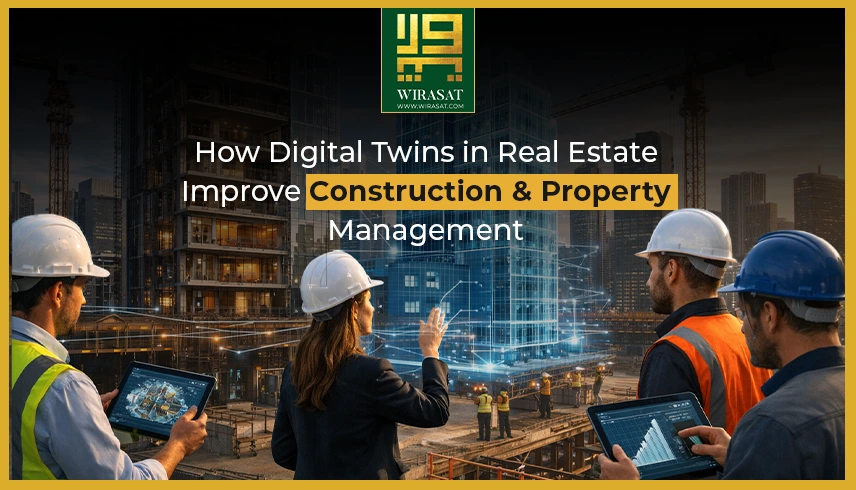
Digital twins in real estate are changing the property and construction industry across the world. Advanced technologies are now used by developers to gain efficiency and minimize risks. Additionally, digital solutions supply correct data to make better decisions. As a result, there is increased growth and innovation in the real estate industry.
Real estate digital transformation concept deals with the incorporation of technology in the planning, construction and management. Thus, developers and investors enjoy competitive advantages. Also, technology improves transparency and operational control. Consequently, the industry is going towards smarter and more sustainable solutions.
What are Real Estate DigitalTwins?
A digital twin is an imaginary replica of a physical structure or house – a 3-D simulation. It resembles the physical property except that it resides in a computer or an app. A digital twin includes all the information: the design, structure, wiring, plumbing, and even the real-life behaviour of the building.
Imagine you are providing your building with a digital brain; it can tell you what is going on in it and when it needs some care, and how to save energy.
How Do Digital Twins Work?
Real estate digital twins are constantly informed about the real world. It is akin to providing a health check to your building: in case something is not functioning well, e.g. leaky pipe or faulty air conditioner or an inefficient energy system, you can easily recognize it and repair it before it turns out to be an expensive issue. Sensors and smart devices in the building measure information about such things as:
- Temperature and humidity
- The consumption of electricity and energy.
- Plumbing systems and water flow.
- Air quality and ventilation
This is all transmitted to the digital model in real time to give a live interactive version of the building. The builders, property managers or owners can now view how the building is performing at any given time.
Why Can Digital Twins Be Used in Pre-Construction?
Digital twins in real estate are not just applied to completed buildings, but it is applied even prior to construction. By developing a virtual 3D model of the envisaged project, architects, engineers and builders can:
- Have a complete picture of the project before the groundbreaking, layouts, materials and systems.
- Find flaws in design during the early stages; structural flaws or wasted layouts, which are expensive to modify later.
- Build up the plan in phases and bring timelines closer to the truth and resources more easily managed.
- Experiment with various conditions digitally, such as energy efficiency, exposure to sunlight, ventilation or even human traffic in business premises.
Digital Twin Technology and Real Estate Development
The use of a digital twin in real estate significantly enhances project results. Developers are able to review building performance at design phases, which identifies potential problems beforehand. Predictive analytics prevents delays and budget overruns.
The technology also improves cooperation between architects, engineers, and contractors. The centralised data ensures that everyone operates with current information,hence better coordination and fewer communication gaps.
AI in Real Estate Pakistan and Trends
In Pakistan, AI is influencing the use of digital twins in large cities. The investors are becoming more informed in their investment decisions as developers are increasingly using Artificial intelligence in real estate to examine the trends in the market and performance of individual properties.
In Pakistan, smart housing societies and commercial projects are adopting technology at a high rate. The interest of the government in smart cities results in more inventions, speeding up the digital transformation of the property sector.
Smart Buildings Technology Integration
The integration of smart building technology with digital twins is very beneficial in enhancing building performance. Smart sensors update data on energy consumption, occupancy, and maintenance requirements, enabling property managers to manage operations effectively.
Digital twins facilitate proactive maintenance schemes. The construction systems self-regulate to reach efficiency and comfort, reducing costs to operate in the long term and assisting in attaining sustainability objectives.
Digital Twins Benefits Builders, Owners and Cities
The outcomes are impressive as more builders and cities incorporate the concept of digital twins in real estate. As a developer, homeowner, or city planner, digital twins have vivid benefits that save time, money and effort and provide a better experience to all involved.
– Reduce Construction Mistakes: All people have access to the same digital plan and there is less confusion.
– Reduced Costs: Early identification of the problems translates to reduced waste and rework.
– Improved Customer Satisfaction: Builders will be able to provide homeowners with digital documents and maintenance software.
– Intelligent Maintenance: The system will remind you to service your AC or repair a leak.
– Transparency: You are fully aware of what was in your walls or roof, no mysteries.
– Increased Property Value: Properly maintained and reported houses sell quicker and at a higher price.
– Smart Urban Planning: Digital twins allow city planners to simulate the behavior of traffic, water, or energy systems.
– Sustainability: Assists in minimizing energy consumption and waste, contributing to green objectives.
Global Digital Twins
Digital twins are emerging as a common feature in global real-estate construction. They save millions of dollars and make buildings more efficient, sustainable and smart.
A complete digital twin of the entire city was developed by the government of Singapore to control infrastructure and city planning. The smart buildings in Dubai are monitored by energy consumption, air quality, and maintenance through digital twins. In the U.S. software like Digs and Cityzenith use twins powered by AI to construct and manage buildings in the future.
Building Information Modelling (BIM) in Pakistan and Digital Twins
The combination of Building Information Modeling (BIM) and digital twins will offer effective developer solutions. BIM provides the detailed 3D models during design and digital twins expand the same into the building lifecycle.
This integration provides real-time monitoring and performance optimization opportunities and facilitates efficient facility management once completed. Developers are able to optimize the building value and life, and the maintenance planning becomes more accurate and cost-effective.
Smart Building Technology
Embracing smart construction technology will improve project management. The digital twin systems are supported by IoT devices, drones and AI analytics which provide developers with real-time data of the construction work.
Predictive analytics is better in terms of resource planning and budget, whereas automation minimizes human error. As a result, businesses become more efficient and profitable and the safety monitoring helps in protecting workers in the sites.
Digital Twins in Property Management
The digital twins facilitate efficient property management. Real-time dashboards enable managers to monitor the performance of buildings remotely and easily identify maintenance problems.
Digital monitoring enhances energy management. Predictive maintenance reduces repair expenses and downtime, enhances living and working environments by tenants, and increases property owners gains on investments.
Digital Twins in the Real Estate Future
Digital twins are a key to the future of real-estate digital transformation. The future of AI and IoT will lead to a smarter building.
Predictive analytics will be a more popular platform to plan and manage developers, and smart city projects will boost the need to develop sophisticated solutions. In this way, digital twins are transformed into an industry standard, and investors emphasize technologically advanced properties.
Conclusion
In real estate, the digital twins are transforming the construction and maintenance of property. The developers have better planning, lower cost and more operational efficiency. There is also the use of technology to make smarter decisions in project lifecycles.
The real-estate industry will change very fast as technology is embraced. Digital twins provide an advantage to companies, and digital innovation is the future of property development and management at the global level.