
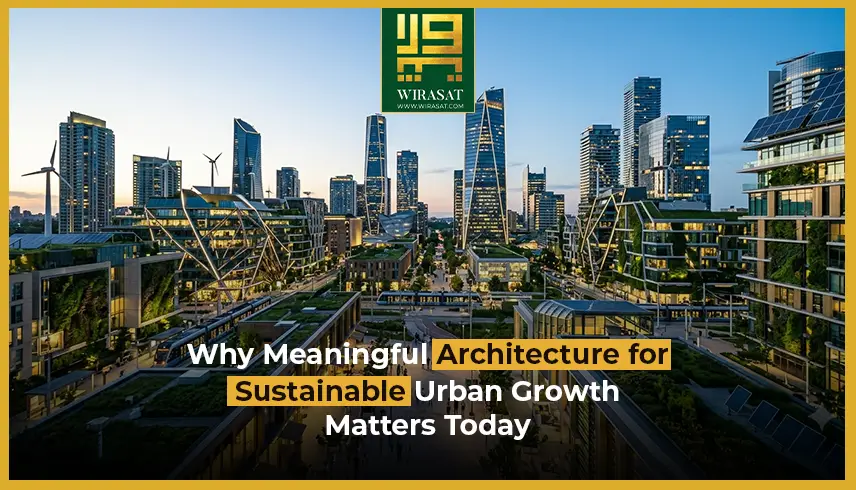
Skylines in cities of the world are growing and spreading out, however, not everything is developed equally. Urban development is too frequently motivated by speed, profit or even a sense of aesthetics but findings of the buildings that look spectacular but have no connection with people, place or purpose.
However, there is a superior route. With meaningful architecture, it is possible to develop not only outward, but also upwards cities, stronger, more communal, and more sustainable.
Why Meaningful Architecture for Sustainable Urban Growth Matters Today
Cities are growing very fast and planners are under pressure today. Thus, sustainable urban development would require meaningful architecture to create balanced development. Architects should not create spaces that serve people and nature separately. In addition, careful planning enhances living standards in societies.
Urban growth tends to disregard the environment and social requirements. As a result, improper planning acts as a source of congestion, pollution and strain of infrastructure. Meaningful architecture, however, is concerned with human benefit in the long term. It incorporates sustainability, culture, and functionality in each structure.
Pakistan has an increasing urbanization rate that is rising faster than the capacity of its infrastructure. Hence, urban areas need smarter building approaches urgently. The architects need to solve the problem of housing shortage, environmental pressure, and the health of the community in parallel.
Purpose-Driven Architecture
Design must never be without purpose. In such a manner, Purpose-driven architecture is a transformative process in cities. The purpose of buildings should not be solely commercial, but social. In addition, the deliberate design enhances energy conservation and management.
Intentional spaces allow healthier living and socialization. As an example, commute distance is significantly decreased when mixed-use development is involved. As a result, the cities are made livable and cleaner. Culturally relevant designs are also ways in which architects reinforce the identity of the community.
Developers are becoming more aware of the economic gains of intentional projects. Green buildings minimize the expenses incurred in operation. Thus, investors benefit financially and environmentally. The balance contributes to the stability of the city in the long term.
Green Building Enhances Environmental Fluctuation
The construction trends around the globe are still affected by environmental concerns. Therefore, sustainable architecture is very important in future urban planning. Designers are now focusing on renewable energy, efficient materials and climate-responsive structures. Moreover, green technologies minimize emissions of carbon.
Indoor comfort and health are also enhanced by energy-saving buildings. Lighting and ventilation is natural and promotes productivity and well-being. Thus, sustainability can be of benefit to both the environment and its occupants. Architects need to incorporate ecological thinking into all the developmental stages.
Green spaces are also included in dense cities by urban planners. Parks, rooftop gardens, and vertical forests enhance the quality of the air. This leads to improved mental health results among urban residents. Sustainability planning empowers resilience to climatic challenges.
Sustainable Architecture
Islamabad and Rawalpindi are two cities in Pakistan that are expanding fast. As this rapidly grows, there is opportunity as well as challenge. What can be done to make architecture and urban development meaningful: sensitive to culture, locality, landscape and long-term worth, as opposed to decorative or hypothetical. Pakistani meanings of architecture:
- Observing local climate, culture and building traditions.
- People-centred design, not cars or facades.
- Be flexible and reusable.
- Introducing transparency and trust in construction and investment.
Human-Centered Architectural Design
People should always be given more importance than structures. Thus, Human centred architectural design is one that is user centered and accessible. Designers give attention to movement trends, emotional reactions and everyday activities. Consequently, spaces can be more practical and friendly.
Human-centred planning is a great benefit in the areas of people. The use of walkable streets promotes healthy living and less car-dependence. Additionally, convenient infrastructure can be used to make everyone inclusive. Space planning also enhances the safety created by architects.
Human-centred designs are also applied in educational establishments and work places. Favourable conditions enhance levels of concentration and productivity. This leads to better performance and satisfaction of organizations. This is because people would flourish when areas accommodate their physical and emotional needs.
Pakistan Urban Growth Challenges
The problems of urbanization are complicated and should be addressed urgently. As such, issues faced by Urban growth in Pakistan include infrastructure stress and environmental deterioration. The lack of affordable housing also leads to the growth of informal settlements. Additionally, transport systems are not keeping up with the rising demand.
Urban development is also complicated by water shortages and energy shortages. Cities are forced to implement more waste-saving building methods. Therefore, sustainable architecture is not an option but a necessity. The policymakers need to implement laws that will facilitate responsible construction methods.
The governance of cities also is important in solving the problems of growth. Open planning systems promote investor confidence and trust within communities. Thus, governmental and non-governmental cooperation is essential. Urban management enhances economic stability in the long run.
Pakistan Modern Architecture
Design trends are changing with the advancement in technology and society. Therefore, Modern architecture in Pakistan represents innovation, sustainability, and cultural fusion. Modern constructions are built using high-tech materials and intelligent technologies. Also, architects play with daring shapes and practical designs.
Cities have innovative architectural expressions in their skylines. Nevertheless, contemporary designs have to deal with environmental realities in a responsible manner. Consequently, sustainability is a crucial aspect in modern projects. Ecological awareness should always be in line with innovation.
Global design standards are being adopted by younger architects. This results in the international recognition and competitiveness of local architecture. The quality of the design in the country is also improved by education and professional training. Things are advancing with the evolution of architectural thinking.
A Future Built with Intention
Meaningful architecture is not a luxury or an afterthought, it is a strategy of creating better cities. It challenges us to take our time, to look further and to plan, not only to the current skyline, but to that of the future. Due to the fact that purpose-based, empathetic, and place-based buildings do not just fill cities, they do more than that.