
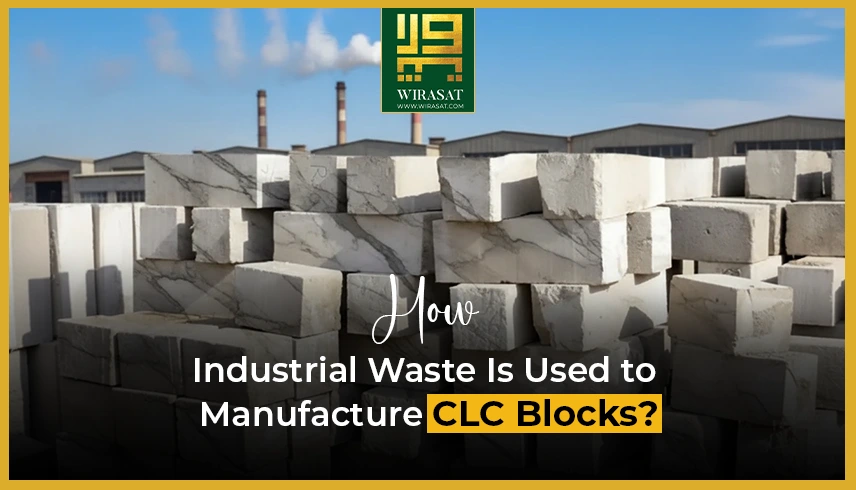
CLC Blocks
CLC blocks are an excellent choice in the modern world due to waste management issues and the desire of the construction industry to acquire more environmentally friendly materials. These are environmentally friendly blocks which are light in weight, strong, and made of industrial waste which has been converted to useful building materials.
CLC is an abbreviation of Cellular Lightweight Concrete. The blocks are manufactured through the combination of cement, water and a foaming agent that creates air bubbles in the mixture. These bubbles make blocks light in weight and highly insulating.
Compared to traditional clay bricks or heavy concrete blocks, CLC blocks are lighter, more sustainable, and easier to work with and therefore, it is best suited in modern construction.
Process of CLC Blocks Manufacture
Cellular Lightweight Concrete (CLC) blocks are easy to produce, energy-saving and eco-friendly. When compared to normal clay bricks, CLC needs neither burning nor high-pressure autoclave, which greatly saves energy and carbon emissions.
It is a simple but a high-tech process:
- Preparation of Slurry -Cement, fly ash (or other industrial waste), and water are combined to a smooth slurry.
- (Foam Generation) A foaming agent is a protein or a synthetic foam agent and is added to water in a foam generator to create foam.
- Mixing – The slurry is mixed with the foam to get the required density.
- Casting – Foamed mixture is poured into the molds of the desired sizes.
- Curing – The blocks are left to dry after demolding and then cured with water or steam, 7-14 days, to acquire strength.
The outcome is a lightweight, uniform and durable construction block that is environmentally and structurally acceptable.
The blocks of CLC provide better insulation since the air pockets minimise heat transfer. The temperature is kept constant indoors, and the blocks are sound-absorbing, which reduces the noise pollution in the cities. These advantages improve the comfort of occupants and energy efficiency.
What Waste Products are used in CLC Blocks?
The most amazing aspect of these sustainable materials is that they can include industrial by-products that are used to build landfills. CLC blocks used together with waste can up to 40 per cent reduce embodied energy in comparison to conventional concrete.
Block CLCs are in line with green-building requirements, where waste of materials and energy is minimized. The fact that they are bigger compared to normal bricks makes them faster to construct, and this reduces the length of the projects and increases sustainability. Developers are moving towards CLC in eco-friendly projects.
These wastes contain abundant silica and alumina and are pozzolanic. They combine with lime to create substances that enhance the strength and stability of concrete.
The Use of CLC Blocks in Water-Prone Areas
Block CLCs contain low water absorption capacity -far lower than clay blocks or AAC (Autoclaved Aerated Concrete) blocks. They have a closed-cell structure that keeps small air bubbles inside which does not allow water to creep through. This renders the blocks very impervious to moisture which decreases cracks, dampness, and efflorescence in walls. These carbon-reduced materials are particularly applicable in water-prone localities like coastal, high-rainfall, foundations or cellar, and bathroom and water tanks (as exterior coats).
The Use of CLC Blocks in Water-Prone Areas
Combined with sustainability and strength, CLC blocks are the perfect option when it comes to contemporary and environmentally friendly buildings. They reduce the environmental effects and increase the performance of buildings. Key advantages include:
– Waste Use: Divert huge quantities of fly ash, slag and dust in landfills.
– Lightweight Construction: less dead weight on structures, reducing the costs of foundations.
– Energy Saving: Good insulation makes the interiors cool in summertime and warm in wintertime.
– Sound Insulation: Air bubbles are natural sound barriers.
– Economical: -Reduced weight results in reduced transport and handling expenses.
– Reduced Carbon Footprint: Reduced cement consumption will result in reduced CO 2 emissions.
CLC Blocks in the real World
The CLC technology is currently used in large infrastructure projects in India, China and the Middle East to convert fly ash produced by local power plants into valuable building material. They are cost-effective, environment-friendly, and durable, which makes them ideal in large-scale real estate and infrastructure projects.
New Standard of Building Materials
The example of recycling of construction waste by the CLC block manufacturing demonstrates that sustainability and innovation can be compatible. It addresses both the disposal of industrial waste and sustainable building. With the CLC blocks, developers and building companies are developing more green, more durable, and less expensive real estate, making waste into strength.
Conclusion
There is a strong step towards sustainability by using industrial waste to make CLC blocks. The construction industry reduces environmental impact through the recycling of waste. Cellular Lightweight Concrete blocks are durable, efficient, and eco-friendly, and they contribute to the low-carbon construction project in the world. CLC blocks are bound to keep influencing sustainable construction in Pakistan and other countries as demand increases.



Comments are closed