
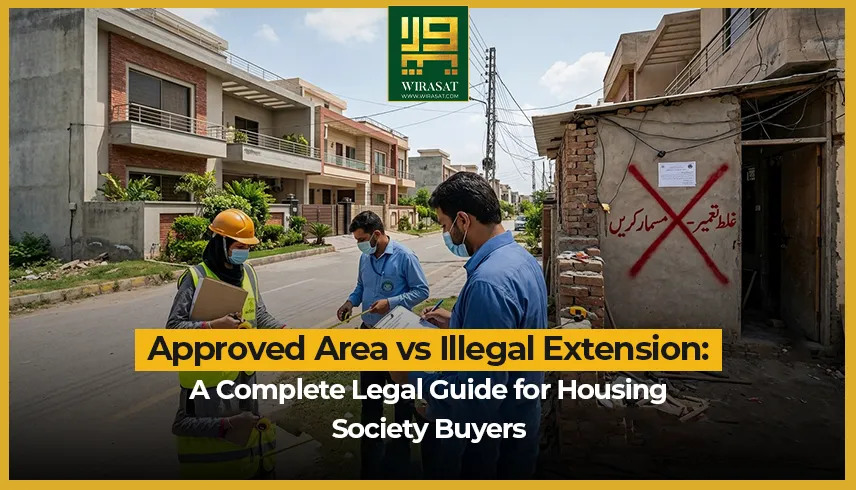
Purchasing property is among the most significant monetary choices any person could make. But many buyers are concerned with only location and price. They tend to disregard the legal status of the housing society. In the process, they become victims of fraud, delayed possession or loss of funds. It is important to understand the difference between Approved Area and Illegal Extension before embarking on investing in any residential or commercial project. You can make proper decisions and protect your investment by having a clear understanding. Furthermore, the legal approval process brings peace of mind and security in the long run.
What Does Approved Area Mean in a Housing Scheme?
Approved area refers to the specific land area, layout, roads, residential plots, commercial plots, parks, graveyard, public buildings, utility spaces, access roads and community facilities which have been reviewed and approved by the relevant authority. In Islamabad, it can be CDA in the case of schemes dealing with CDA jurisdictions. Depending on the specific location and legal nature of the project, RDA, PHATA, TMA, the district council or other relevant authorities may be involved in Rawalpindi.
An effective approval is not just a society name that’s written on a brochure. It is linked with Layout plan, land area, khasra numbers, mouza, road access, zoning, public use area, mortgage of plots (where applicable), development obligations, utility planning, and final NOC status. The buyer should be aware that approval is contingent on a particular plan and a particular piece of land, not upon limitless future land surrounding the project.
For instance, if a society has an approved layout on a particular number of kanals, then only the approved kanals are considered part of the society under legal planning status. If the society subsequently acquires, claims, negotiates or plans further land and commences selling of further blocks without proper revision of approval, then that additional land should not be automatically deemed to have been approved. The buyer needs to check if the exact extension has its own approval, revised layout plan, land ownership and legal basis from the respective authority.
In simple terms, “approved society” doesn’t mean that all receipts sold by that society are safe. Block, exact plot category, exact file and exact map location shall be the same as the approved layout.
What Is an Illegal Extension?
An illegal extension is an extension which has been added, advertised, booked or sold outside the approved layout plan without the appropriate authority. It can be added to an existing society, re-branded, or sold as a new release of a well-known project. At other times, it appears very convincing as the society’s original land might have roads, gates, offices, maps and development activity.
The buyer will recognize a name and know that the new block must be safe as well. Legally, an extension is not automatically approved because it is close to or linked with an approved project. Requires appropriate land ownership, planning permission, re-layout, NOC process and conformance with authority regulations.
Illegal extensions can be hazardous as they give a false sense of security. The buyer is not investing in a totally new project; the buyer believes he is investing in a known society. That is how to understand that this risk is even more hidden than the risk of dealing with the illegal society.
Housing Society Approved vs Unapproved
Paperwork is not the only distinction between an approved vs unapproved housing society. Authorities have granted permissions to an approved society, and it has met legal requirements. An unapproved society is a society that has not gone through the necessary legal processes.
Authorities keep an eye on approved societies, making them more secure to invest. However, construction bans, legal challenges, and infrastructure deficits can occur with unapproved projects.
Furthermore, projects that have received approval are likely to have higher resale values and are more likely to be sought by buyers. In addition, the investors can also make it simpler to secure bank financing as well. So, if you opt for an approved housing society, your risks of investing are minimised.
Distinguish between LOP and NOC
There is a lot of confusion among many property buyers about legal documentation. Knowing the difference between LOP and NOC is a way to avoid making expensive mistakes.
A Letter of Permission (LOP) will permit the developer to plan and develop under approved conditions. A No Objection Certificate (NOC) is a document that verifies that the project meets the legal conditions imposed by the relevant authorities.
Both of them are crucial documents, but have different purposes. The buyer needs to ensure that the society holds valid approvals, not just based on the promotional material. As a result, it is advisable to read both to ensure your legal protection.
Difference Between Approved Area and Sold Area
One of the largest concerns in real estate is the distinction between approved area and sold area. In some cases, the developed plots are more than the legally sanctioned land. This practice exposes buyers to a lot of legal problems.
For instance, if a society gets approval for 5,000 plots, and it sells 6,500 plots. The additional plots are typically not within the approved limits or are merely on paper. Thus, buyers may never be able to acquire their property.
So, always check the “approved” layout plan against the developer’s sales map. This simple step helps to determine unauthorized expansions before investing.
Overselling plots in housing schemes
Over-selling plots in housing schemes has become a frequent occurrence. The unscrupulous developers intentionally sell more plots than there is land to sell. At first, the buyer is not aware because they don’t have to move into the home until years down the road.
But serious issues arise once the buyer is ready to take possession.. Many people could be the owners of the same plot. Others find that there are plots allocated to them that are in an unauthorized extension.
Furthermore, overselling delays development, leads to legal issues, and impacts the investor’s trust. Thus, checking the availability of the plots prior to buying must not be neglected at all.
Illegal Extension in Housing Societies Risks
However, there are other risks associated with illegal extension in housing societies. The extension may be found illegal, and any investment made will be lost.
There are several significant dangers, such as:
- The cancellation of plot allocations
- Poor access to water utilities
- The failure to pass on the right of ownership
- Poor infrastructure development
- Reduced property value
- Conflict with police and officials
- Problems obtaining bank loans
Further, unauthorized extensions have to develop more slowly as government departments do not approve public services.
Price negotiations should always be preceded by legal verification as well.
What exactly is a Housing Society Approval Process?
The process of approving a housing society includes multiple legal steps that are to be followed prior to the sale of plots by the developers.
The process typically comprises the following:
- Land ownership verification
- The layout plans are to be submitted
- Environmental approvals
- Infrastructure planning
- Development authority inspections
- The issuing of preliminary approvals
- Final approval, NOC
All stages ensure planning regulation compliance. Hence, a better level of legal protection for investors is provided by approved societies.
To purchase, buyers are advised to seek copies of the official approval documents rather than take verbiage from sales personnel.
Property Legal Status: What does it mean?
One of the best things to do before investing is to check the legal status of the property. Legal status is confirmation of whether the property is located within the approved boundaries and adheres to the government regulations.
By having a legally verified property, the buyers are safeguarded against potential ownership claims, illegal development and legal issues in the future. Moreover, properties with a clear legal status have a higher market demand and are gaining value.
Investors are advised to cross-check records with the relevant development authorities and land departments before making any financial commitments.
How to Avoid Property Fraud in Pakistan?
To prevent property fraud in Pakistan, one must know how to avoid such fraud. Fortunately, several precautions have been taken to minimize investment risk.
Please always check the official approvals with the relevant development authority. Also, please consult documents relating to ownership before paying. Do not use brochures or advertisements as the sole source of information.
Whenever you come across legal documents that seem difficult, you should always consult with experienced property lawyers. Furthermore, don’t rely on online marketing; visit the project site in person.
Don’t accept offers that are significantly lower than normal since they may contain undisclosed legal problems. Last but not least, only buy homes from developers whose experience can be trusted.
Best Way to Verify a Plot Before Buying
Buying with a single verification is not the best way to verify plot; rather, it should be done through multiple legal checks.
Check with the relevant authority first to ensure that the society has been approved. Then, compare the approved layout plan with the plot position that is offered. Check the ownership and development permissions.
Also, conduct a site inspection to validate infrastructure development. Getting information from existing residents is often helpful and can offer important insights into issues that are currently being addressed; this should be done when possible.
Last but not least, get legal advice before entering into any contract. This small investment could save a great deal of money in the long run.
Common Warning Signs of Housing Society Fraud in Pakistan
Unfortunately, there are thousands of people who are being taken aback by housing society fraud in Pakistan annually. Recognizing early warning signs will keep investors safe.
These are warning signs to look out for:
- Unusually low prices
- Missing approval documents
- The pressure to pay up-front
- Unclear ownership records
- Promises without written agreements
- Ongoing re-planning of master plans
- Failure to fully develop due to lack of funds
Furthermore, it is essential to always check every claim on its own merits. Don’t believe marketing claims, believe official records.
Conclusion
For any property buyer in Pakistan, the concept of Approved Area vs Illegal Extension is crucial. Investment decisions should always be preceded by legal verification. Those who are aware of the difference between approved housing society and unapproved housing society, LOP vs NOC, Approved area vs sold area, and the procedure for housing society approval greatly minimize their investment risk.
Besides, an awareness of the dangers of illegal extension in housing societies, knowing what illegal housing schemes Pakistan are, understanding what is meant by overselling plots housing societies, checking the legal status of the property, understanding what is meant by no land file meaning and what the risks are, and knowing how to check the best way to verify plots before buying will allow you to safeguard your hard earned cash.
Last but not least, if you know how to prevent property fraud in Pakistan, you can be confident in your investment in legal projects instead of illegal extensions in housing societies Pakistan and the rising issue of housing society fraud Pakistan. An investment that has been verified by law today will help to give financial security for tomorrow’s peace of mind.
Frequently Asked Questions (FAQs)
Please refer to the official website or office of the appropriate authority, e.g. CDA, RDA, PHATA, TMA or other local authority. Don’t just take screenshots, dealer messages, YouTube videos or social media posts.
Approved area refers to the land and layout that is officially approved by the relevant authority. The land, plots or files offered to buyers is in the status of sold area. Sellers of plots or files outside of a society’s approved layout may face legal consequences, including invalid ownership claims.
No. The approval of the main society does not automatically result in the extension block’s approval. The extension needs to be planned into the approved layout or its own revised approved plan/NOC from the relevant authority.
“No land file” is a file that is present in society’s records and/or the market, but insufficient quantities of purchased, approved, demarcated and deliverable land are available. The buyer might possess a receipt or file number, but the plot itself may not be on an approved map or ground.
Some societies start to sell their future blocks before the land is purchased or approved. They sell files, receive installments and inform buyers that approval/land acquisition is ongoing. If it is not approved or the land is not purchased, then the buyers may end up with a weak file.



Comments are closed