
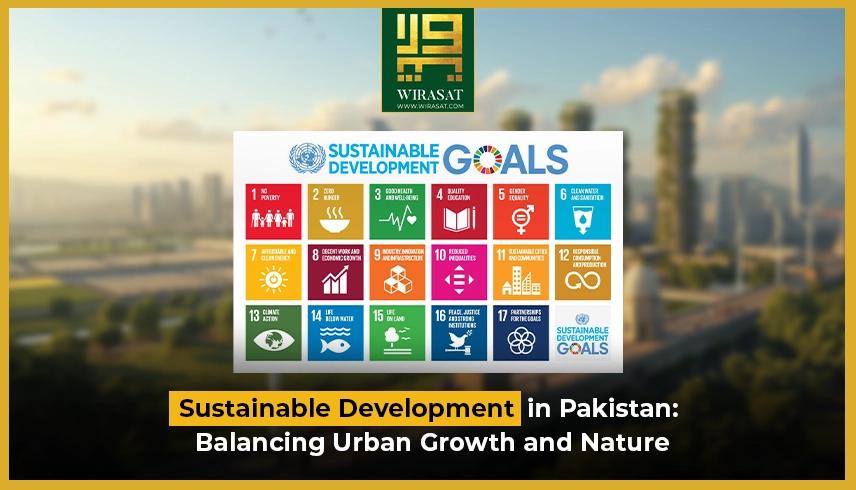
Sustainable Development in Pakistan: Balancing Urban Growth and Nature
Introduction
The fast process of urbanisation and economic ambitions collide with the severe environmental issues. With cities becoming larger and the infrastructure becoming modernised, the need to develop sustainably is now more than ever. There should be a balance between urban development and environmental conservation to assure prosperity, climate stability and quality of life to future generations.
Sustainable development in Pakistan implies expanding the economy while maintaining the environment, safeguarding the culture and empowering the people. It disapproves of the harmful course of pollution, the pollution of rivers and the blind cutting down of trees, but rather enhances human well-being without depleting resources to be used by future generations.
Among the 17 Goals of Sustainable Development, the United Nations addresses clean energy, climate action, poverty eradication, education and so on. These are not just aspirational goals; they give a global framework on which Pakistan can model its development.
Rapid Urbanisation and Construction of Infrastructure
The growth in the infrastructure in Pakistan has been escalating over the last twenty years. Large cities like Karachi, Lahore, Islamabad, and Faisalabad have grown tremendously due to population surge, rural to urban migration and economic activity. The design of new highways, flyovers, underpasses and metro buses is aimed at reducing traffic congestion and enhancing movement in cities.
Meanwhile, high-rise apartments and other massive housing developments are under construction to facilitate an increasing housing need. Though vertical development is more efficient in the use of land compared to sprawl, the uncontrolled growth might overstretch available water resources, energy networks, and garbage-collection facilities. To avoid environmental degradation, sustainable planning must be considered.
Climate Susceptibility, Repeat Flooding and Strain on Resources
Pakistan is one of the most climate-changed areas, with melting glaciers, heat waves, and unpredictable monsoons. Millions of people were displaced by devastating floods in 2022, infrastructure was destroyed, and the price of disregarding ecological vulnerability was shown. The rapidly growing population and urbanisation strain water supplies, agricultural land and energy systems.
CPEC and Urban and Economic Development
The projects of the China-Pakistan Economic Corridor (CPEC) represent one of the most radical projects in the history of Pakistan. CPEC will enhance the economic growth and connectivity between regions with energy plants, road networks and industrial areas. Nevertheless, the environmental risks associated with large-scale projects include loss of land, air pollution and carbon emission.
It is important to incorporate sustainability in CPEC. The use of renewable energy and green construction can help to make sure that development does not impact negatively on natural ecosystems. Sustainable CPEC projects may become a prototype of responsible infrastructure in the region.
Environmentally Friendly Buildings and Urban Planning
Smart city planning and green architecture presents a good solution. Green buildings are concerned about energy conservation, natural illumination, rainwater collection and eco-friendly material, energy consumption, prices and influence on the environment.
Smart cities employ technology in controlling traffic, waste, water conservation, and power savings. Islamabad and Lahore are slowly moving towards smart systems, yet further usage is required. Urban areas can be developed wisely to avoid the exploitation of natural resources.
Reforestation and Ten Billion Tree Tsunami
To achieve a balance between development and conservation there is a necessity of nature-based solutions. The Ten-Billion-Tree tsunami is a historic program to reverse the ruined landscapes, expand forest area and climate change. Millions of trees capture carbon dioxide, lower erosion on soil, control temperatures and curb floods. Reforestation (particularly in cities) can be expanded to increase resilience to climate change.
Enhancement of Over Road Transport
Construction of roads tends to boost traffic and pollution. Rather, it is necessary to invest in clean and reliable public transport. Cities like Peshawar and Lahore have developed bus rapid transit (BRT), reducing emissions and saving commuters money. Public transport uses less fuel, less traffic jams and less air pollution as well as being more inclusive, benefiting students, workers and low-income families.
A Balanced Approach
To achieve sustainable development, there should be alignment between the government, the private sector and communities. Environmentally friendly buildings should be promoted through policies, rules and the creation of renewable energy. Education and awareness to the people is also important in a way that they are educated about responsible consumption and care of the environment.
To achieve a balanced model of growth, Pakistan should consider the concept of sustainability in urban growth and invest in green infrastructure and conservation of the natural ecosystems. Green cities will not only bring about economic growth but also a cleaner atmosphere, safer societies and a healthier environment.
Conclusion
Sustainable development is not a choice in Pakistan; it is a necessity. As a result of the fast urbanisation, growing infrastructure and increased risks of climate, Pakistan needs to seek a symbiotic development model with nature. Pakistan can achieve resilient cities that preserve natural heritage by intelligently planning its future, green architecture, better transport, and helping the Ten -Billion Tree Tsunami. The correct strategies can ensure a sustainable and successful future although difficult.