
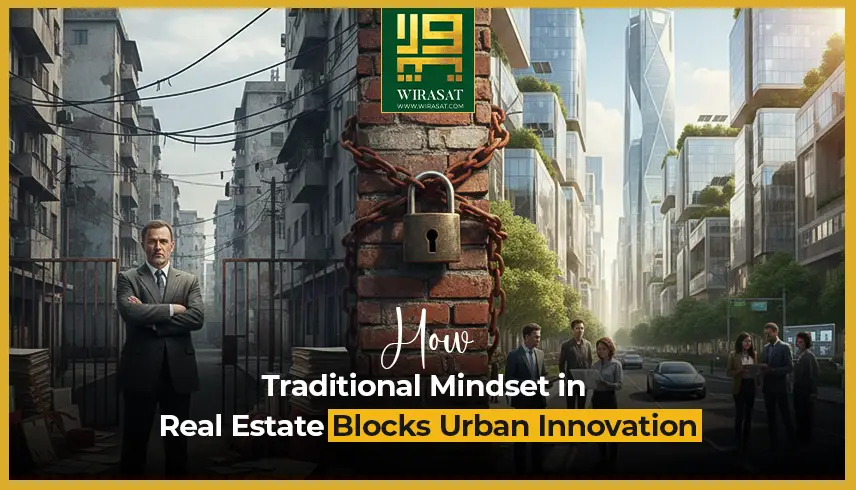
The world is becoming more and more urban; cities are more intelligent, connected, and tech-driven. However, there is another hurdle: the conventional thinking on real estate. Finance, healthcare and transport are already driven by innovation, and real estate holds onto old beliefs and systems. This resistance prevents economic growth and a sustainable plan.
Traditional Mindset of Real Estate
The conventional real-estate mentality is based on established standards, paper-trailing and risk-aversion. The developers, investors, and regulators tend to adhere to the practices that they have relied on over the decades. Experience is important, but too much results in stifling innovation and contemporaryity. Therefore, cities are unable to integrate sophisticated technologies into infrastructure and real-estate markets.
What are the Traditions Linked to Real Estate?
It focuses on tangible resources and ignores data-oriented decision-making and intelligent tools. These gaps become more visible as cities expand. These deeply rooted beliefs, rituals and unwritten rules govern the market today and tend to stifle innovation.
Resistance to Structural Flexibility
Builders and investors prefer fixed and time-tested layouts since they are easy to copy and sell. Tailoring in terms of layout, materials, or functions is considered unnecessary or potentially dangerous.
House over apartment
In most cultures, independent houses are regarded as the epitome of wealth and achievement, and it is therefore preferable to building apartments.
Bigger is better
Customers prefer large size to space-efficient designs and aesthetic, or traditional features, such as balconies, columns, arches, over functionality.
Face-To-Face Transactions
The customers base their decisions on face-to-face deals where they meet brokers and use paper records, more than the digital platform which is more transparent.
Cynicism Of Contemporary Payment Schemes
Rent-to-own, subscription housing, and fractional ownership face reluctance; consumers desire large down payments and conventional bank financing.
Preferences In Conservative Architecture
Buyers prefer more familiar, culturally symbolic designs; sloped roofs, decorative balconies, which they associate with comfort and tradition, thus making developers reluctant to innovate e.g. with glass facades, green roofing, modular layouts, biophilic elements etc.
Ethical Purchasing Instead Of Rational Investment
Houses have been purchased on emotional basis like family heritage, prestige, social image and not because of utility, sustainability and ROE.
Reduced Confidence In Tech-Based Procedures
Investors do not trust digital property, smart contracts, or virtual tour services and want to visit sites in person, do paperwork manually, and use a legal framework.
What is Urban Innovation?
Urban innovation involves using new ideas, technologies and systems to create, operate, and experience cities in a better way. It addresses issues such as lack of housing, traffic jam, pollution, garbage, and energy use smarter, more sustainable and inclusive.
Urban innovation goes beyond the infrastructure to include social, economic and environmental innovations that make cities habitable and efficient and future oriented. Key components are:
Smart Infrastructure
It involves application of IoT to smart lights, water systems, and traffic lights. Smart grids maximize energy flow and sensor-driven waste collection and real-time information systems are also included in smart infrastructure.
Housing and Real Estate Innovations
Modular and prefabricated building, affordable housing, like micro-housing, co-living, rent-to-own, etc. Sustainable materials and green building standards assist in scaling down of the traditional construction models.
Sustainable Mobility
More sustainable commuting is provided by scaling up bike-sharing, e-scooters, and public transport, car-free zones and pedestrian neighborhoods. Traffic intelligent systems are also important to minimize traffic jams and pollution.
Environmental Solutions
New environmental reliefs include urban agriculture, green roofing, and vertical gardens. Composting schemes, circular waste systems, carbon-reduction schemes and air-quality monitoring schemes are also significant.
Economic & Social Innovation
Inclusion policies make sure that there is development to benefit marginalized communities. Nowadays, a flexible zoning that encourages live-work-play communities is a necessity.
Resistance to Real Estate Innovation
The issue of resistance to innovation in real estate: It is a huge challenge to urban development. Stakeholders are afraid that technology will overtake already established models and are concerned of high cost or lack of technical expertise.
Opposition slows the passage of smart initiatives; the innovative ideas are viewed in distrust rather than welcome. Cities then fail to enhance housing, transport, and commercialisation through technology.
Conservative Real Estate Market and Urban Growth
Conservative real estate market: Experiences consistency, predictability, and historical returns. Although it will decrease the short-term risk, it constrains the long-term development. Investors prefer conventional housing and business models to mixed-use or smart developments.
In this way, cities cannot make landscapes more varied. Urban development is strict and unproductive, with modern life demanding fluidity, greener structures, and technology.
Mindset and Culture that impact development
Development is based on mindset and culture. In most areas, top executives are not ready to embrace change as they are used to the old systems. Decision-making remains centralized and slow with minimal innovation.
Organizational culture tends to be hostile to cooperation with tech startups, preventing the flow of knowledge and delaying the process of digital adoption. In the long run, urban areas fall behind the world in terms of standards.
Traditions vs Innovation in Modern Cities in Real Estate
The future of urban development is the struggle between the real-estate traditions and innovation. The traditions emphasize ownership of land, tangible resources, and manual evaluation practices, whereas innovation emphasizes efficiency, sustainability, and intelligent integration.
Traditional cities are finding it difficult to cope with the rapid development of population. On the contrary, the innovative cities rely on technology to optimize land use, alleviate congestion, and increase living standards. A balance of tradition and progress defines the success in cities.
Digital transformation in real estate
Urban innovation opens with the digital transformation. Big data, artificial intelligence, and cloud platforms refine the accuracy of planning and efficiency. The digital property-management systems simplify the transactions and increase transparency.
The digital tools enable governments to survey urban development in a better manner. The industry is transformed by smart zoning, predictive analytics, and virtual property tours. Cities that adopt digitalization have a competitive advantage in attracting investment and talents.
PropTech in Pakistan
The use of PropTech in Pakistan is still in its initial phases with barriers of thinking and regulations. Online property portals and digital management tools are being introduced by startups, although they are not widely accepted yet.
Face-to-face transactions and informal records are still popular with many stakeholders. Nonetheless, gradual change is being driven by increasing urbanization and demand by the youth. PropTech can change the urban real-estates in Pakistan with the support of policies and awareness.
Smart Cities and Sustainable Development
Modern urban planning requires smart infrastructure. Connected utilities, smart transport systems and energy-efficient buildings enhance the quality of life. Automation based on data saves on waste and cost.
The conventional models of planning do not usually combine these technologies, which leads to traffic jams, energy deficits, and ecological issues. Smart infrastructure will allow cities to expand sustainably and satisfy current needs.
Blockchain in Real Estate and Transparency
Blockchain is a solution to long-term problems of fraud, delays, and distrust. It generates safe, unchangeable ownership and transaction records of property, decreasing conflicts and fostering investor trust. Cross-border investments are also simplified, and verification is accelerated by blockchain.
Although it has advantages, conventional mindsets tend to slow down the adoption. To modernize urban property markets, it is necessary to educate the stakeholders on the value of blockchain.
The Future of Urban Innovation in Real Estate
The city has to be innovative by accepting technology and valuing localities. Cities have to leave the old ways behind and embrace smart solutions. The future of real estate is based on digital platforms, smarter infrastructure, and open systems. With the increasing global competition, any city that is not able to change risks being left behind. Adapted ones are appealing to investments, talent and long-term developments.
Conclusion
A conservative attitude about real estate remains an obstacle to urban innovation. The cities are not evolving due to resistance to change, conservative markets, and old practices. Digital transformation, PropTech, smart infrastructure, and blockchain will offer obvious answers.
With a change in mind and culture, real estate will be able to propel urban developments rather than impede them. Innovation is not a choice anymore, but a necessity in order to create smarter and more sustainable cities.